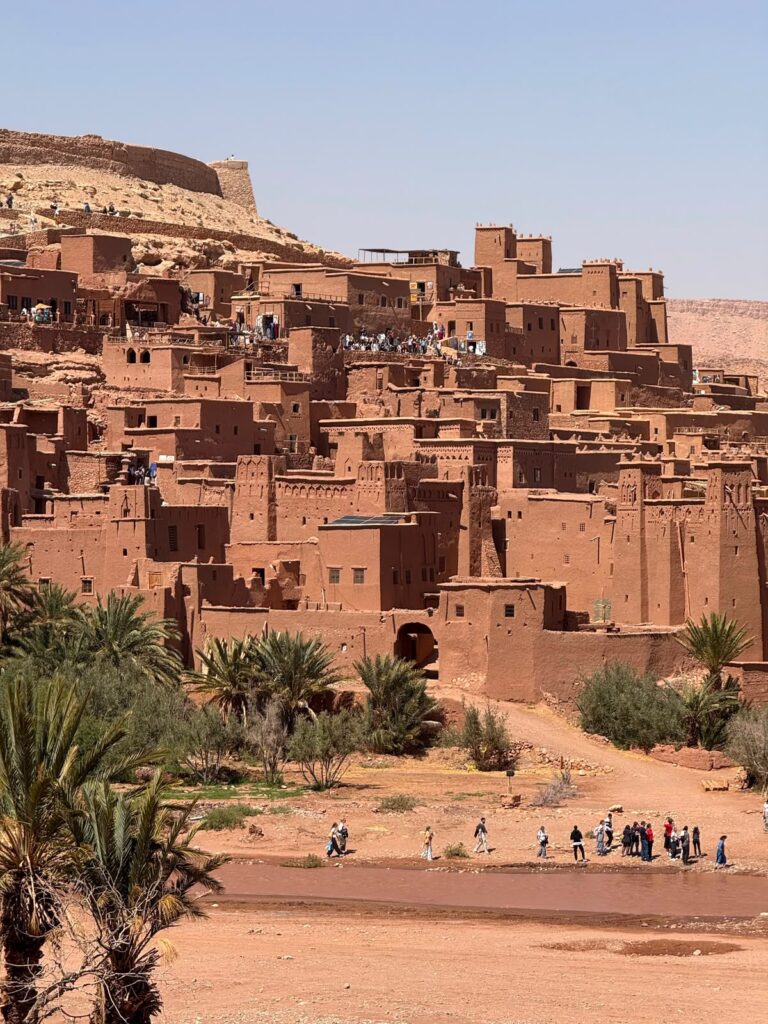
Every tour bus that stops at this Ait Ben Haddou film set tells the same story. Gladiator filmed here. So did Game of Thrones, Lawrence of Arabia, and The Mummy. The guide points at a tower, someone takes a photo, and the group moves on within the hour.
What almost nobody mentions is different. A handful of families still actually live inside those walls. Their relationship with the place is a lot more complicated than the film trivia suggests.
From Caravan Stop to Film Set.
Ait Ben Haddou started as something much less glamorous than a filming location. Instead, it sat on the old caravan route between the Sahara and Marrakech. Merchants and travelers stopped here on their way north or south.
Local families built their homes from packed earth, known as pisé. The houses layered up a hillside above the Ounila river, and generations lived there.
Then, through the 20th century, most Ait Ben Haddou residentsThe reasons came down to practicality, not dramatic. Earthen homes need constant upkeep, and cracks have to be repaired every year after the rains. Modern life, running water, electricity, easier access, sat on the other side of the river. Most of the population moved to a newer village built directly across the Ounila. They still live there today.
Later, the old ksar became a UNESCO World Heritage Site in 1987, a status that still shapes how it can be restored today. That’s around the same period international productions started noticing it. Its Berber name is Ighram N’Ait Haddou, and this Ait Ben Haddou film set has since appeared in more productions than almost anywhere else in Africa.
Who’s Still There at the Ait Ben Haddou Film Set.
Estimates vary depending on the source. Generally, most put the number at somewhere between four and six families who still live inside the ksar year-round. They’re the ones responsible for its actual survival.
Every year, these families re-plaster the walls after erosion. They manage the small irrigation channels that keep the internal gardens alive. This is the maintenance work that keeps the earthen structure from washing away entirely.
Some of these families also run small shops inside the walls. Typically, they sell rugs, paintings on goat skin, and other crafts to the tourists who pass through. It’s not an easy trade to characterize.
Several travelers who’ve written about their visits describe the souvenir stalls differently. Some call it more of a marketplace than a heritage site. One traveler’s guide reportedly told his own clients not to buy anything inside, since some goods are shipped in rather than made locally. Others describe the same interactions as warm and low-pressure, an invitation to tea before anyone mentions a sale. Both versions are probably true, depending on which street you’re on and which day you visit.
What the Money Actually Does
A recent conservation report from CRAterre, the French earthen-architecture research institute, worked on the site with Morocco’s heritage authorities. It made a point worth sitting with. Tour operators, airlines, and souvenir traders based in Marrakech draw substantial revenue from this Ait Ben Haddou film set’s fame. Most of that money never reaches the people who actually live there.
Overall, a small number of local guesthouse owners benefit. The families maintaining the ksar itself, largely, do not.
The report described this imbalance as something the local population considers unfair. It called for better sharing of tourism revenue as part of the site’s long-term management plan. This is a rare piece of official documentation on Ait Ben Haddou families that says plainly what a lot of visitors sense but rarely hear articulated. Hollywood productions and UNESCO status brought fame, but that fame hasn’t translated cleanly into income for the people whose homes the film crews actually use.
A Quieter History Most Visitors Never Hear
Before it became Yunkai in Game of Thrones, Ait Ben Haddou had a religious mix that’s mostly forgotten today. The Amazigh population that once lived here included Jewish families. A synagogue building from that period still stands in the village, largely unremarked in the standard tour commentary. It’s a detail worth asking a guide about directly, since it rarely comes up unprompted.
Visiting the Ait Ben Haddou Film Set Honestly
Still, none of this means Ait Ben Haddou isn’t worth seeing. As a Gladiator filming location and a Game of Thrones set, it draws crowds, but it’s also one of the best-preserved examples of southern Moroccan earthen architecture anywhere. Indeed, the view from the hilltop fortress, looking down over the towers and the dry riverbed, is genuinely one of the more striking sights on the Marrakech-to-Sahara route.
Still, it’s worth crossing that footbridge with a clearer picture than the film trivia gives you. After all, the people still living inside those walls aren’t extras or set dressing. They’re the reason this Ait Ben Haddou film set is still standing at all. They do maintenance work that UNESCO listing pays for only in part, while getting a smaller share of the tourism economy than the industry built around their home.
If you stop to buy something from one of the stalls inside the ksar, that’s a small way of putting the visit back on its actual terms. So is taking a few extra minutes to ask a resident about their family’s history there, rather than just photographing the walls.
We stop at Ait Ben Haddou on several of our Ait Ben Haddou Ouarzazate tours, and we build in enough time, usually an overnight in nearby Ouarzazate, so the visit isn’t just a twenty-minute photo stop between longer drives. To ask about adjusting the pace of a visit here, contact Navigate Morocco.
Ait Ben Haddou Film: Related Private Tours
Related private tours from Navigate Morocco: